Sunday, December 2, 2018

Creativity and College

Creativity is used in many aspects of life like economics, arts, and education. Creativity is important because it allows people to come up with solutions to problems which helps with the growth of the world around us. Creativity can be defined as small things that you do every day like painting or floral arrangement. Or creativity can be defined as large field changing ideas.

Everyday creativity is important in college because it opens your mind to new ideas that could be used for helping you with things like college assignments or separate problems that affect your life outside of college. Academic innovation is important in college because it brings new ideas to the teaching of students making the process of learning easier. This helps students learn and could show students new ways of learning that may be helpful in their life.

In college, universities are using academic innovation and are developing innovation centers for improving student success. Innovation centers try to improve student success by implementing new ideas like revamping courses and training professors to teach students with active learning in mind. Colleges display academic innovation by doing things like cross-disciplines, experimental and community-connected projects, and new learning opportunities.


When practicing everyday creativity, you develop new ideas about those activities. This is important because it shows you more options that can be done and explore more solutions to problems. It’s important to not just learn using new tools but to innovate and utilize the tools you currently use in a new way. This is how you can promote and grow your knowledge at a faster rate than before. Being able to innovate your learning process and make it better can transfer into how you acquire knowledge in the world outside of college or inspire you to come up with new ideas for learning outside of college. Innovating how you gather knowledge from new and different sources is what helps you grow and allows you to learn the most amount of ideas that you could utilize in your life.

Saturday, December 1, 2018

Creativity on College Campuses

     Creativity is defined as the use of the imagination or the creation of original ideas. It can be expressed multiple ways, and everyone uses it differently and for different things. One thing that I noticed when I got to college was that creativity had not disappeared and it was still very much present in everything we did. Each day at college I saw how James C. Kaufman and Ronald A. Beghetto’s four-c model of creativity was used. Kaufman and Beghettos claimed that there were four parts to creativity and each one was a different level. Each different level of creativity is expressed all over college campuses. Sororities and fraternities are good examples of creativity on college campuses. They each have their own creative ways to keep the members involved in their courses and activities happening on campus, whether it be through the semis, fundraisers, or the big and little program. Fundraisers are especially a big way of showing creativity. There are no limits or expectations on how to do a fundraiser, so sororities and fraternities can use their imagination and come up with their own creative ideas. Athletics are also a good example of creativity on college campuses. Players can use creativity while practicing, watching film, and executing plays. To be their own self and play how they want to play they have to use their imagination and creativity. Creativity helps students and athletes succeed in college and can lead to future success. Using sports and activities, everybody will express their own creativity in a different way. Not all will be classified as having Big-C or Little-C creativity. Thats why Kaufman and Beghetto created the Pro-C and Mini-C of creativity. It gives those who don't fit in the Big-C or Little-C to still be classified as being creative and using their mind and imagination. 

Creativity Everyday

When I look at my phone every day I can only think; whoever thought to make this little box thing? From playing with Pokemon cards in the schoolyard as a kid to now driving around playing Pokemon Go on my phone, the technology from the last ten years is jaw-dropping. Now that I'm in college attending the University of North Florida, I see how every generation has a new set of goals that are driven by the last generations creative ideas. I have seen that college is the starting point for new technology through academic innovation. Academic innovation can be defined as faculty and students seeking to build or use the knowledge and skills to create and affect things in interesting and positive ways, while the pure definition of creativity seems to be missing. These two concepts go hand-in-hand and can be seen at thousands of universities across the United States.
Image result for creativity together
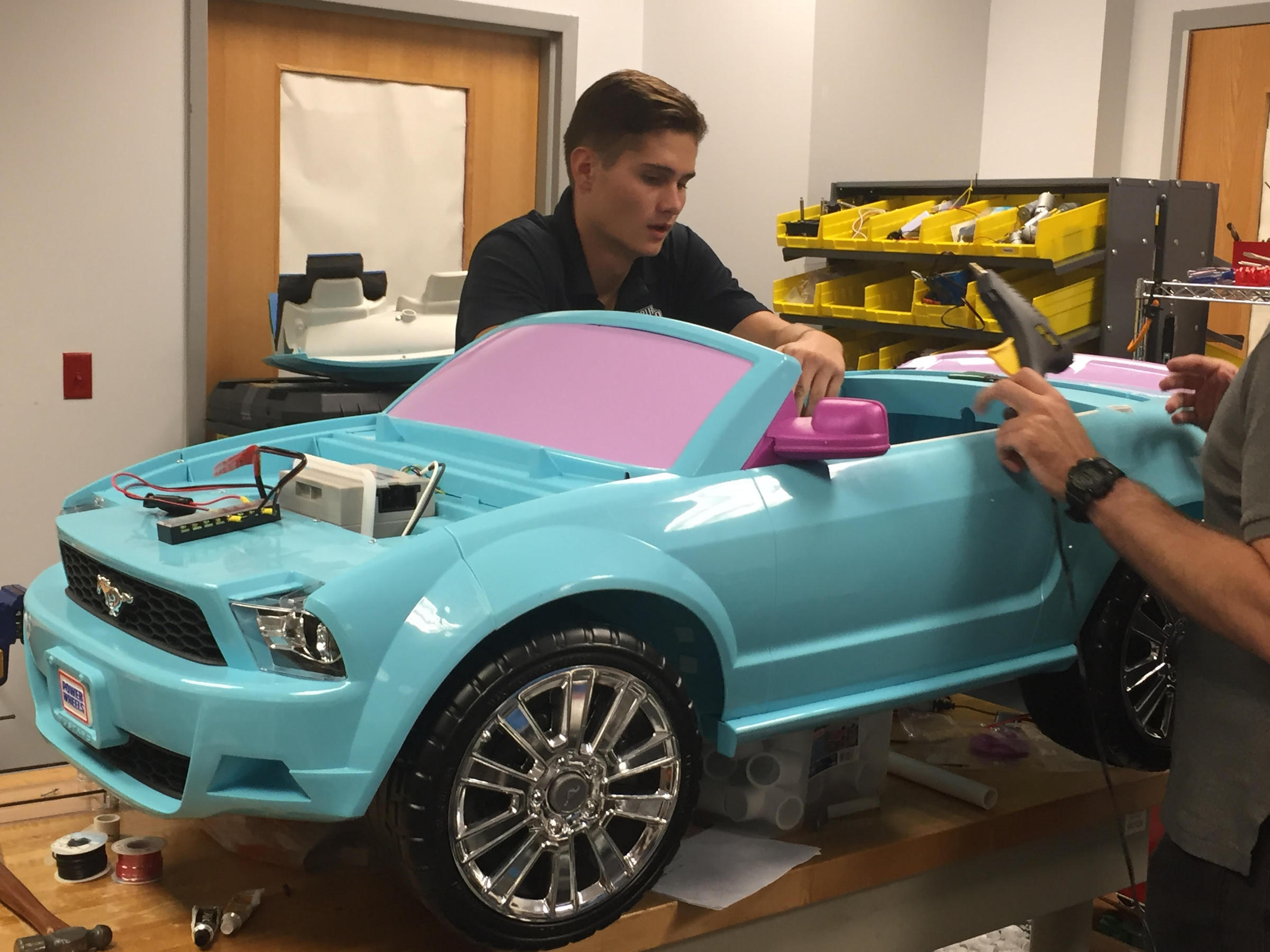
          One specific of academic innovation example is the engineering students at UNF are making electronic toy cars for children with disabilities. These little toy cars designed by students have high-tech features to match those of the life-size versions. These students, ones just like you and I, all have different creative ideas that blossom into something that our and past generation find astounding.
UNF mechanical engineering student Kristian Sipos works on a car for a young child with disabilities.
What studies have shown is that the idea of creativity is a cloud that can “rain” down many sub-categories with different kinds of creativity. The idea of creativity can be seen as a “pass or fail” type of topic but instead, should be seen as many different types of creativity based on the action being performed. Practicing academic innovation is an extremely complex task, the 21st century's technology is only increasing because of this practice.

Our Environment and Our Creative Voice

        Every day, every moment, our brains our processing massive amount of data and deciding what to do with that data. We, as members of a society, send out information to each other in any creative form we have available to us. Every card we send, or movie we recommend, or carefully crafted text is a creative form of sending information to one another. We enjoy receiving new interesting ideas from others, as well as seeing others enjoy what we give them. This supports us sharing creatively among ourselves every moment.  But is this really effective? Does it really support creativity, or just doing what we expect others want to see?

There is so much we don’t tell each other, so much we carry with us that we don’t think anyone should know. This leads to blind spots in knowledge. We keep information to ourselves to play it safe. Sometimes it’s to avoid an argument, or to save someone’s feelings, or just to save ourselves expected embarrassment. Our environment supports this, especially on college campuses. In so few classes can we vary far from the guidelines. We are allowed to, no one is telling us we’ll fail or that certain new ideas will be met with harsh criticism. We just get the feeling. The feeling that it isn’t worth the risk. Why would we put forth someone new, something against the grain, when the alternatives are tried and true? If we vary to much from the mean, we know we’ll stick out. We see others that stick out, most of us can’t even imagine being like them. We would hate to expose ourselves like them, leave ourselves bare, be judged by others as we have judged. We would much rather watch what succeeds and attempt our best emulation.

This is where the problem originates. We all just emulate what is right, what we see our environment accept. This leaves us all with the same voice, the one we use to play it safe. This is hardly the creative voice we want from others. Yet by not truly letting others know they’ll be accepted, that ideas beyond convention can be added to the conversation, we practically forbid it. When we learn a craft, much of that learning is simply to focus our voice, make it digestible for others. This takes out our true voice, and the rest of our learning is to make is successful. We learn how to make it seem new and creative.  We add to the problem. It’s the same logic that keeps Dictators in power. Not that any one person is in charge or commanding us, but it is the environment we create for ourselves that dictates us. A Dictator rules through power and fear. But where does that power and fear lie? In those who work under them, also held by power and fear. If everyone together tried to over through the Dictator, he would be powerless, he is just a man. It is too with this fear. It is nothing, we create it, but it rules over us. The only solution to this problem is revolution. Every voice saying what they truly think. Only then can we have true creativity.

It isn’t our fault. As humans, our basic instincts say to follow the pack, be safe, agree with those in charge. It isn’t our bias or upbringing, but our own adaptations that have sentences us to live with this fear. This isn’t a fear of failure, or of others, but of ourselves, and what we truly think.

The 4 Stages of Creativity

When you think of someone as 'being creative', we automatically assume that they are creating new ways to look at the world around us either through art or science. This narrow thinking, however, is not always an entirely accurate way to describe someone's creative capabilities. A simple decision of what tie to wear is a perfectly good example of creativity being performed on a daily basis. These different acts of creativity can be broken up into four levels to measure; min-C, little-C, pro-C, and big-C. The two researchers that came up with the 4 C model were James Kaufman and Ronald Beghetto, the authors of Beyond Big and Little; the Four C Model of Creativity. Their model attempts to break down the original two broad levels of creativity, big-C and litle-C, so that creativity can be more accurately measured.The little-C is commonly associated with everyday creativity, like performing your job at your workplace. Big-C is for those individuals that have mastered a subject and is noticed for it, whether it they found an alternative treatment for cancer with positive results or they wrote a hit song heard on the radio. Mini-C is below the little-C level and consists of the creative process that someone goes through when learning a subject, like learning to tie a tie. Pro-C is between little-C and big-C and is for those who have surpassed others in the subject but has not yet mastered the field enough to be recognized for it. In consideration with these different levels of creativity that are measured, it is safe to say that we are all creative at least once a day, even if you don't realize that you are. The decisions to study art, to change your hairstyle, or to start a family are what make us unique and creative in our lives.

Friday, November 30, 2018

Are students at the University of North Florida using the resources provided for Academic Innovation?


The question is, are college students using the resources that universities make available to them?  Depending on the college or university, the number of resources being provided may vary. However, most schools give out the resources students need to transfer the knowledge acquired from high school, and put it to good use in college. Whether it's a community college or a university, academic innovation is indeed possible to accomplish. Even for a small school like the University of North Florida, it has countless tools that benefit students academically. From Greek life and academic organizations, to study abroad programs taken place around the globe. There’s no excuse for students to say that there are not enough resources. Fairs and events taken place at the student union are constantly being held to promote clubs. Some instructors and professors even offer research study participation which can really open doors for new opportunities.
 The most prominent part of achieving academic innovation isn'y solely what is being provided by the schools, it is what the students does with the resources they receive. Really, students have only two options, you either use the tools and try to achieve academic innovation, or you don’t. You won’t really know what you’re capable of achieving if no effort is being made. College is the place in order to do so, there are countless of opportunities given out that create the basic foundation of academic innovation, but it’s the students job to take those opportunities and challenge themselves for self-actualization. For people unfamiliar with the term, self-actualization this is a psychology term coined to express people who have reached their maximum potential of their talents: a state in which people are at their very best. “A dream becomes a goal when action is taken toward its achievement.” —Bo Bennett


Tuesday, November 27, 2018

What's To Know About Creativity?

Nipper, Kyle 
What’s To Know About Creativity? 


When dealing with something like creativity, which is abstract and intangible, and not to mention totally random at times, it seems difficult to pinpoint a single factor which makes certain individuals much more creative than others. While a biological basis for creativity could definitely exist, due to the intangible nature of it, I believe environment plays a role just as crucial a role in creative development. Without the proper environment to foster creativity, it would be much more difficult for it to thrive. That being said, certain individuals seem to be gifted with their creative abilities, and a biological explanation for those outliers would really shed some light on the subject for most. 
Image result for abstract concepts
Creativity is an abstract concept, but research has found that could link it to a scientific basis. In a text titled Brain Structure Links Everyday Creativity to Creative Achievement written by Wenfeng Zhu, Qunlin Chen, Chaoying Tang, Guikang Cao, Yuling Hou, and Jiang Qiu, they explain that link. The authors of the text have conducted research and they state “We found that every day creativity was positively correlated with the volume of the right premotor cortex” (Zhu et al. 138). Since they conducted the studies themselves, I would believe them to be credible sources. The authors of this text relate to another work, Beyond Big and Little: The Four C Model of Creativity by James Kaufmann and Ronald Beghetto. In their text Kaufmann and Beghetto introduce the model to categorize creativity, the 2C system. It consists of a Big/little C/c where the Big C represents grand scale creativity, like creative professionals. Little c represents everyday creativity. Kaufmann and Beghetto believe that instead of the 2C system, a 4C system would be more effective at mapping the creative spectrum. Zhu et al. reference this 4C system in their work.
Image result for someone painting

Studying creativity is imperative to certain fields of work. To understand the nature of creativity and the factors that affect how humans function creatively is vastly important to those who base their entire careers on their own creative output. Artists who sell their paintings for a living must be able to produce paintings which are new and exciting to the viewer of the painting or else it won’t sell. Being self-aware of how to boost creative capacity is imperative to making themselves effective in their respective fields. Being able to control the environment or the thought process could be an invaluable skill to someone whose well-being is defined by their ability to perform creatively. This would be a vastly useful skill to learn for anyone, but it would mainly affect those who are in entertainment or creatively-driven fields. 
In the journal article Creative Days: A Daily Diary Study of Emotion, Personality, and Everyday Creativity by authors Tamlin Conner and Paul Silvia, the style that the information was gathered in was most similar to Zhu et al.’s text, where the information was mainly gathered by the authors who wrote the text. Tamlin and Silvia wrote this article based on information gathered from one of their studies. According to the article, they conducted an experiment where the examinees would write a journal online and would rate their experience between 18 positive and negative emotions. According to the information they received from this study, they found a positive correlation between positive emotions and high creative capacities. Negative emotions also showed an antagonistic effect on the creative output of the individuals. The study is fairly similar to the study conducted by Zhu et al. where the objective was to find a reason for everyday creativity and its variance between individuals. They differ because of different explanations for it. Silvia and Conner posit that creativity is heavily affected by emotional state, while Zhu et al. argues that it is because of the activity of the RMC (right motor cortex). These two explanations aren’t mutually exclusive and both could be correct that both factors have a strong effect on the creativity of the individual. 
Image result for creative spectrum
Categorizing creativity may require more than 4C's but I do think that it could cover a vast majority of it. The issue with trying to categorize something abstract on a spectrum like creativity is that spectrum have so many niches in different areas that make the possibilities seemingly endless. Zhu et al. tries to link the categories of Kaufmann and Beghetto's system to a scientific basis. Experiments done by Zhu et al. found an association between the amount of grey brain matter someone has and their creative capacity. While there is an association, it is not definitive that someone with a higher volume of grey matter in their brain will have a higher creative output. It is not entirely unlikely for an individual to be more creative yet have a smaller RMC or lower volume of grey matter in their brain.
In The Social Spark: How Conversation Triggers Creativity and Insight by Karen Nestor, the idea of “aha moments” are explored. Nestor explained an aha moment as “the sudden experience of comprehending something that you didn’t understand before” (Nestor 1). Nestor elaborates that the area of the brain that is active during one of these moments is the same as the one that is active when comprehending a story. This blog post made by Nestor references a wide variety of cases and studies between her points to strengthen her points. With the backing of several studies, the information contained in the blog post becomes much more credible. The information that an area of the brain that is associated with understanding new concepts is also associated with people reading stories could be revolutionary for the academic field. In terms of academic innovation, instructors structuring their lessons like contemporary stories could be effective in making lessons more coherent for students. This method isn’t tested, but it could be explained given the correlation between the area of the brain that lights up during understanding a new concept and when comprehending stories. 


Image result for UNF gym
A form of academic innovation made at the University of North Florida is the addition of an exceptional gym on campus that is accessible to all students. This addition tackles improving academic success from another angle that isn’t normally addressed. The physical condition of the students can have a significant effect on their mindset in academic settings. According to Nestor’s text, their emotions will have a significant effect on their creative capacity, and normal exercise often has quite a positive effect on people. Going by this frame of thought, including a gym on campus that is accessible to all students would improve the performance of the students. All students aren’t going to use the gym, so the increase in performance wouldn’t be seen across the entirety of the student body, but those that are not opposed to going may find it more appealing since it is already included. One of the ways UNF could innovate academically is implementing adult-themed courses that instruct young adults on tasks that are not explained but expected of adults. Things like taxes, the stock market, finding a job are topics that are never addressed in your average curriculum. The closest the current system comes to addressing any of these is helping students make a resume, and more often then not this resume is geared towards academics as opposed to a job. One of the most effective things that UNF could do to prepare their students is offering courses on how to function as an adult for those who were never taught prior. This could potentially make the students who pass through the system more prepared for what they encounter outside of it. 
Creativity even though it seems erratic at times, can most times be explained scientifically. Despite the correlation with grey matter in the brain or activity of the right motor cortex, creativity has an inexplicable element to it that manifests in certain individuals. With regards to musicians, there are many who practice every day to hone their techniques, but there are also those who can play just as well while putting a fraction of the effort in and naturally connect with the creative medium without excessive practice. This could potentially be explained by the emotional approach from Nestor’s text, but it is only plausible. Though many strive to find a definitive origin for human creativity, due to its intangible nature, it will more than likely prove to be multifaceted and elusive. 

Work Cited: 
Kaufman, James C., and Ronald A. Beghetto. "Beyond big and little: The four C model of creativity." Review of general psychology 13.1 (2009): 1. 
  
Conner, Tamlin S., and Paul J. Silvia. "Creative days: A daily diary study of emotion, personality, and everyday creativity." Psychology of Aesthetics, Creativity, and the Arts 9.4 (2015): 463. 
  
Zhu, Wenfeng, et al. "Brain structure links everyday creativity to creative achievement." Brain and cognition 103 (2016): 70-76. 

Welcome to the Blog!

Hello and welcome to the Creativity in Everyday Academic Life blog. This blog is a place for students in ENC 1101 to share their final cours...